
The Pork Tour Day 4: Lexington, Tennessee

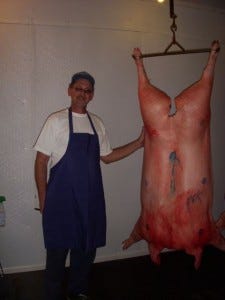
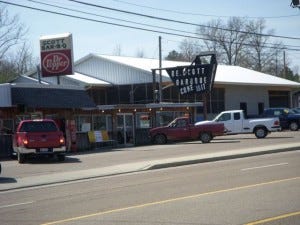
At his diminutive roadside business in Lexington—don’t look for a website, there isn’t one---Ricky Parker sells barbecue. This is like saying that you go to a little street called Broadway to see some folks stand around and read a play out loud. Parker is particular about his pork. You might even say he’s pushy. He doesn’t do pig parts---that’s for amateurs---and he doesn’t use any modern time-savers, like gas, or charcoal. Parker cooks his particular whole hogs for a long time over hickory wood. Period. End of story.
Sort of. This is not your usual backyard or roadside barbecue. Here’s how it works (and, if any of you try this at home, don’t come whining to me when your whole property burns down): A 180-pound-ish pig is split and dressed, and the backbone is cracked so the animal will splay out flat. Then it’s sandwiched between two big layers of flattened cardboard refrigerator boxes. Outside of the cardboard on either side is a big steel grate.
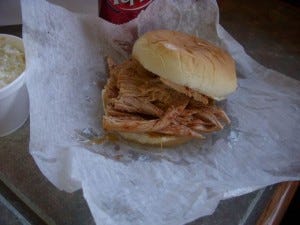
The enclosed pig “cooks” over smoldering wood at about 170F, skin side up, for, say, 15 hours. Then the ends of the steel racks are wired together to facilitate (nice word—this is no way an easy operation) turning, and the whole thing is flipped over. Then---and here’s where it gets sexy---the pig cooks skin side down until Parker pronounces it done. Sexy, because just think about the splendid alchemy that now takes place: the skin acts as a vessel to hold in all the lovely rendered fat, and the meat that’s had 15 hours to start getting tender now poaches in it’s own barely simmering fat for another 8 to 10 hours. Then you dump on some secret sauce and let it all alchemate some more. Finally, you get to eat it. Whole hog barbecue demands much of those who would practice this history-on-a-bun. It’s not big business, but in a small area around Lexington (and in a hog-centric micro-region of North Carolina), whole hog is what people expect and what they get. There are two things people here want: to see and smell wood smoke, and to order by the part. (For God’s sake don’t walk in and just say “Give me some barbecue.”) Middlin is what I like (if it were cured, it’d be bacon), but then I’m a fat whore. You might want shoulder, or even leg.
Ricky and his son Zach take turns watching the fire at night, because watched it must always be. When you have fire and fat confined in a small area, flare-ups are a constant danger. For this reason, the skin of the hog must never get accidentally pierced, if it does the fat will run down into the fire and, well, ignite. So someone, and it’s almost always either Ricky or Zach, has to stoke the fire, poke the hot coals, and watch for escaping fat. Ricky works 19 hours a day, every day, and is basically married to the process. Not surprisingly, his wife grew bored with this situation some time back. “She pulled,” says Ricky, “and left me with the kids.” They burn through 12,000 pounds of hickory a week here, but Ricky gets the off-cuts from a place that turns hickory handles, so it’s a closed circle. And that’s not the only one: “My uncle raises all the cabbage for my slaw, and the red pepper for my beans.
We cut our own slaw, make our own sauce, the only things we buy is chips and drinks.” Why is the business called Scotts BBQ instead of Parker’s? Well, Mr and Mrs Early Scott adopted Ricky at the age of 13, after he’d had a falling-out with his own father. He started working at Scott’s BBQ in 1976. After about ten years, Early Scott decided to look after his ailing wife (whom he hadn’t seen much of during his active barbecuing years). Ricky took over the business in ’89. If you do the math, you’ll see he’s been tending his fires pretty much non-stop for 33 years.
Now, we get to talk about my passion: I ask Ricky what kind of pigs he barbecues. And, here in Lexington, I finally have my porky-piphany: Ricky is the first pork man I’ve met so far on this trip who is not cooking feed-lot pigs. He prefers---no, insists on---a Yorkshire/Duroc cross, and he’s got a source nearby (he’s looking for a back-up source, too; Parker doesn’t ever want to get caught pork-less).
When he went to California, to cook at the Culinary Institute of America’s World of Flavors conference, there was no way to ship out his local hogs. Ricky wouldn’t have gone if he couldn’t have his usual pig. “I won’t cook just anything. I’m very particular on what I cook, and on how I cook,” he says. “I’m not in it for the money, I’m in it for the passion, and people know this about me.” A guy named Larry was able to get him some of his Yorkshire/Duroc cross hogs, and Ricky was the de-facto star of the 2005 conference, especially after the screening of Joe York’s documentary “Whole Hog” (made for the Southern Foodways Alliance of Oxford, Mississippi – ie where I was yesterday; watch it here.) Ricky doesn’t do much traveling. One of the people Ricky met at the California event must have viewed him as an exotic creature. “He says to me ‘You’re very primitive.’ Then he asked me do I live in a house with a dirt floor,” Ricky told me, looking just the teensiest bit as though this might have hurt his feelings. I tell him this is what I admire most about his operation, and also that it was definitely meant as a complement. I’m rewarded with a big grin, something Ricky is well stocked with.
Here’s what I learned: It pays to be particular with your pig. Primitive won’t hurt, either. It’s about Pride of Pork.